Problem Statement & Pain Points
Currently, Creative Arts, Virtual Arts, and Quality Assurance each use separate systems for tracking effort and resource allocation. These siloed tools and processes lead to several issues:
🧩 Inconsistent workflows
Each department uses its own tracking tool and process, making it hard to align and work efficiently across teams.
📂 No centralized data
Effort data is spread out across different platforms, making it difficult to compare or analyze across departments.
👀 Limited visibility
Stakeholders don’t have a clear, unified view of project progress or how resources are being used.
Defining the Problem (How Might We)
How might we unify effort tracking across departments at SIE to improve visibility, reduce inefficiencies, and support better cross-functional collaboration?
Goals
Create a Centralized Tracking System
Design a single platform that consolidates effort tracking for Creative Arts, Virtual Arts, and QA, replacing disconnected tools and streamlining workflows.
Support Scalable, Cross-Department Workflows
Build a flexible system that adapts to each department’s needs while maintaining consistency and supporting long-term scalability.
Improve Visibility for Stakeholders
Provide real-time access to effort data across departments, enabling clearer project insights, better planning, and more informed decision-making.
Discovery - User Persona
To ensure the platform delivers the most immediate and measurable value, Phase 1 is focused primarily on addressing the needs of Individual Contributors (ICs). ICs represent the largest and most frequent user group, and streamlining their ability to log and submit effort data is critical to the overall success of the platform.
By optimizing for IC workflows first, we are able to: ✅ Validate core platform functionality quickly with real users. ✅ Reduce administrative bottlenecks at the source. ✅ Set a strong foundation for secondary user roles (Managers and Finance) to operate efficiently in later phases. Manager and Finance functionalities are kept minimal in Phase 1, focusing only on features necessary to support IC time tracking and approval.

Discovery - Feature Prioritization
Feature prioritization was guided by strategic insights from cross-platform audits, workflow analysis, and stakeholder input across Creative Arts, Virtual Arts, and QA. A Must/Should/Nice-to-Have framework was used to categorize features based on their impact to core workflows, data accuracy, and cross-role usability. Core actions like effort logging, timesheet submission, and approval workflows were prioritized, with enhancements like auto-suggestions, validation checks, and reporting tools planned for future iterations. This approach ensured alignment with departmental needs and long-term platform scalability.

Impact–Effort Matrix
To align expectations across teams and refine the initial implementation plan, an Impact–Effort Matrix exercise was conducted with product owners, designers, and the engineering team. The activity focused on features already identified as “Must Have,” meaning all items were considered high-impact. The goal was to assess relative implementation effort and scope, allowing the team to prioritize quick wins first, followed by higher-effort “big bets.” This collaborative approach ensured functional alignment and helped define a realistic scope for the MVP, setting a clear foundation for sprint planning and subsequent user flow development.

Discovery - User Flow Mapping
With the MVP scope defined, the next step was to map out user flows for key roles, starting with Individual Contributors (ICs). These flows outlined how users would interact with core features such as logging effort, editing timesheets, and tracking submission status. By visualizing these journeys end-to-end, the team was able to identify potential pain points, edge cases, and interface requirements early—creating a strong foundation for wireframing and design.


Design & Prototyping
Wireframing
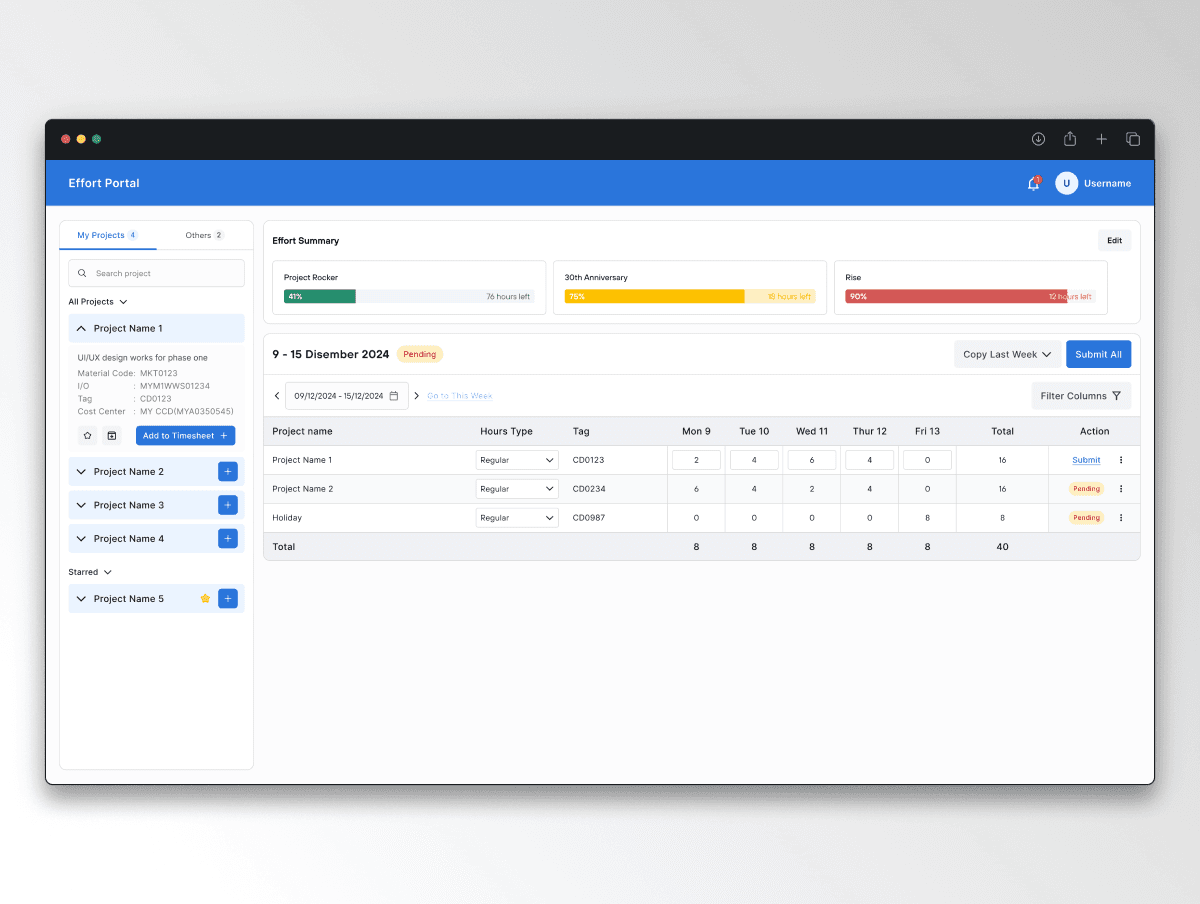
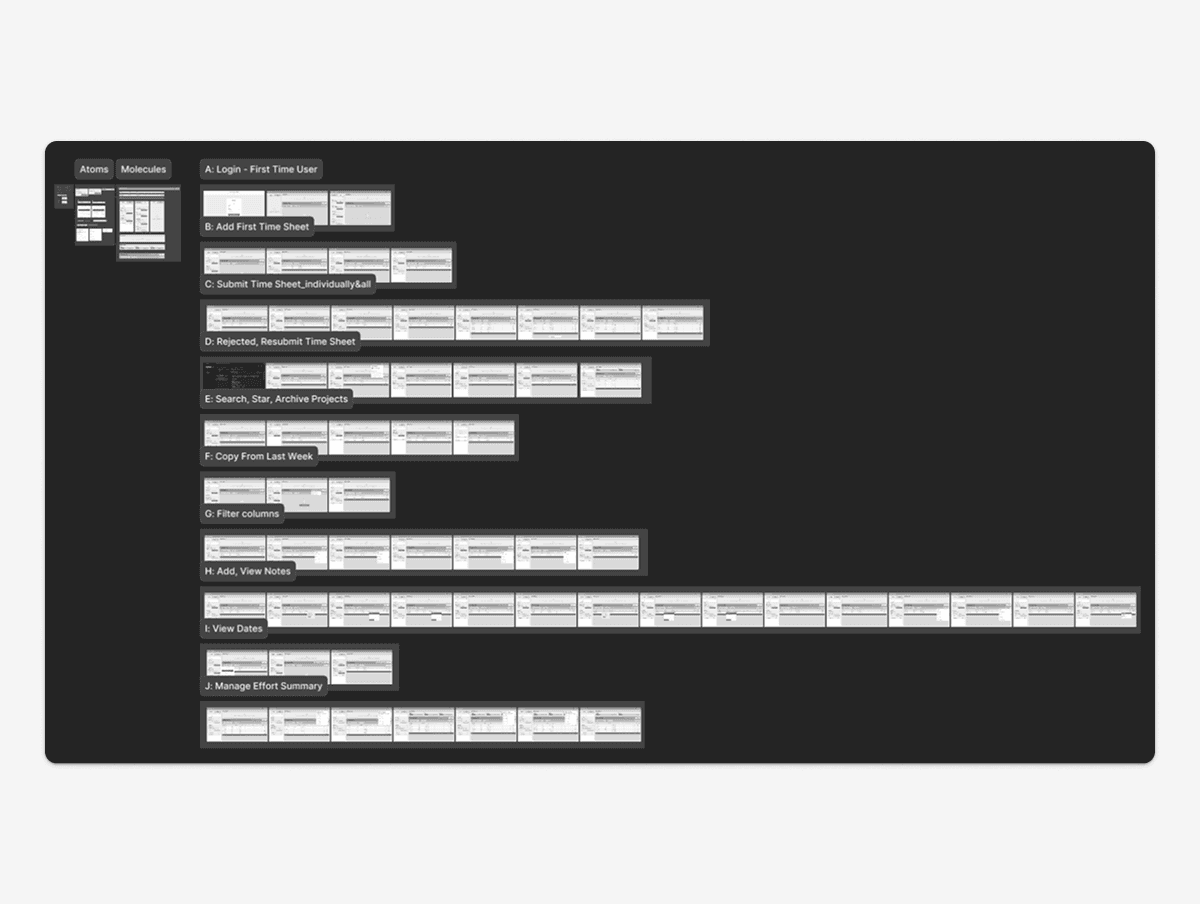
With core user flows mapped, low-fidelity wireframes were developed to visualize key interactions for the MVP. These wireframes focused on layout structure, task clarity, and intuitive navigation for Individual Contributors, while also incorporating necessary interaction points for Managers and Finance users. Priority was given to screens such as effort logging, timesheet editing, submission tracking, and error validation. Early wireframes were iterated based on internal reviews to ensure alignment across design, product, and engineering.
Design System & Visual Approach
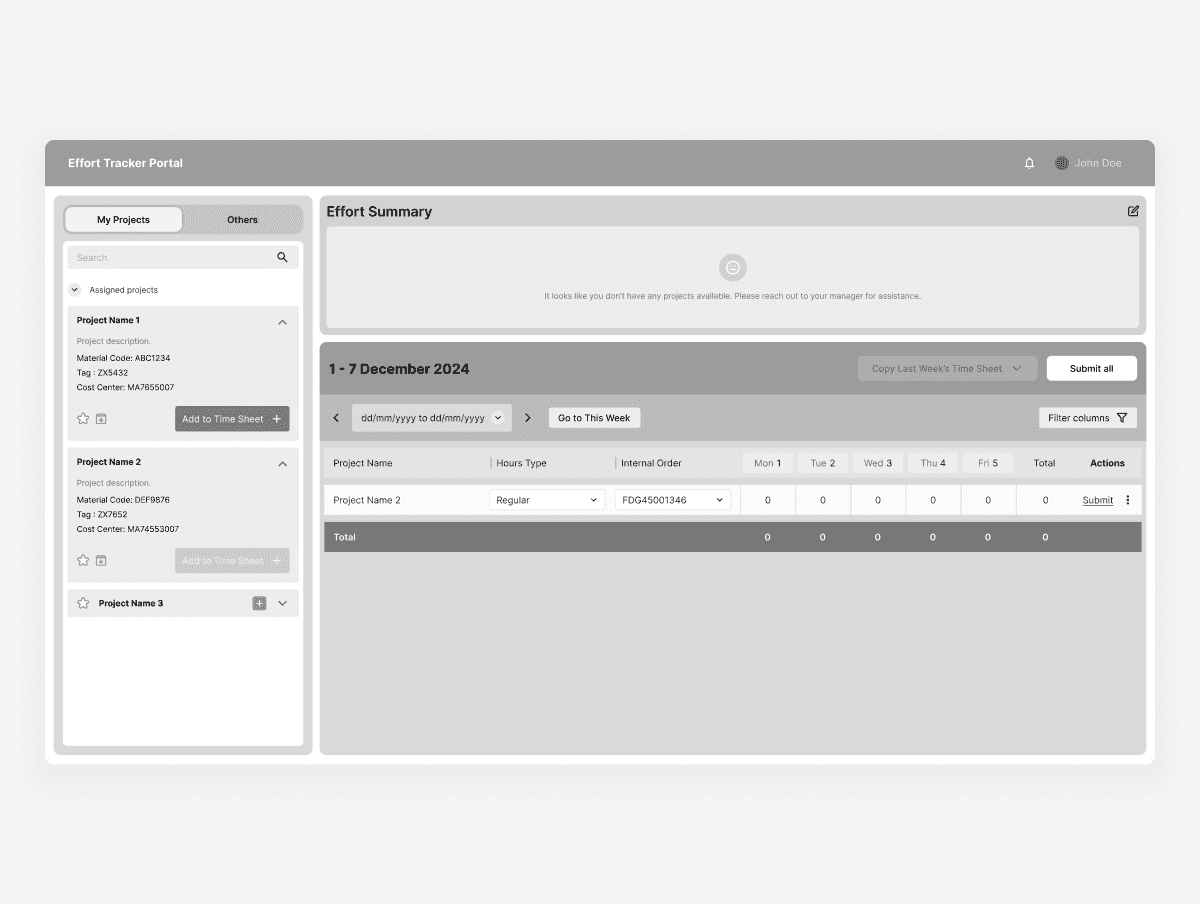
The visual design followed a modern, clean, and practical aesthetic to keep the interface focused, easy to scan, and distraction-free for daily time logging tasks. Clarity, hierarchy, and ease of navigation were prioritized, especially for IC-focused screens like effort logging and timesheet editing. A lightweight design system was built alongside, using reusable components and tokens for color, spacing, and typography to ensure consistency and scalability. Components were kept deliberately lean to meet MVP timelines while supporting long-term extensibility. This system-first approach also streamlined the design-to-development handoff and ensured alignment of expectations across the Creative Arts (CA), Virtual Arts (VA), and Quality Assurance (QA) teams.


User Testing & Refinement
Once the high-fidelity prototypes were developed, user testing was conducted with key stakeholders from CA, VA, and QA teams. The goal was to ensure that the design addressed their core needs and that the workflows for effort logging, timesheet editing, and submission tracking were intuitive and efficient. Feedback was gathered on aspects such as task flow, layout clarity, and usability of key features. Based on the results, minor adjustments were made to improve navigation, clarify instructions, and reduce friction in the most critical workflows. This iterative approach ensured that the design was not only visually aligned with the team’s expectations but also functionally efficient for the end-users.


Iteration & Feedback Documentation
After user testing, feedback was collected and analyzed to identify issues and improvements. Key insights were documented in a Product Outlook, outlining necessary changes and features for the next iteration. This document was shared with stakeholders (product owners, designers, and engineering) to ensure alignment before updates. Each iteration refined the product based on feedback, focusing on enhancing user experience, core workflows, and addressing usability challenges. After completing the iterations, the final design was prepared for handoff to development, completing the process.

Results
Phase 1 successfully laid the groundwork for the Effort Tracking Platform, meeting key objectives through beta testing and gradual implementation across selected teams within the Creative Arts, Virtual Arts, and QA departments.
Centralized Tracking System
Beta testing validated the platform's ability to unify effort tracking across departments, replacing disconnected tools and streamlining workflows.
Scalable, Cross-Department Workflows
Build a flexible system that adapts to each department’s needs while maintaining consistency and supporting long-term scalability.
Enhanced Stakeholder Visibility
Real-time access to effort data improved project insights, planning, and decision-making, as verified by feedback from stakeholders.
With these objectives successfully met, Phase 1 establishes a strong foundation for future iterations, focusing on feature refinement and preparing for a broader rollout in the next phases.
Thank you.